

SC Rejects Suicide Theory in Dowry Death Case, Confirms Homicidal Hanging
 Copy Link
 Share
Share Save
Save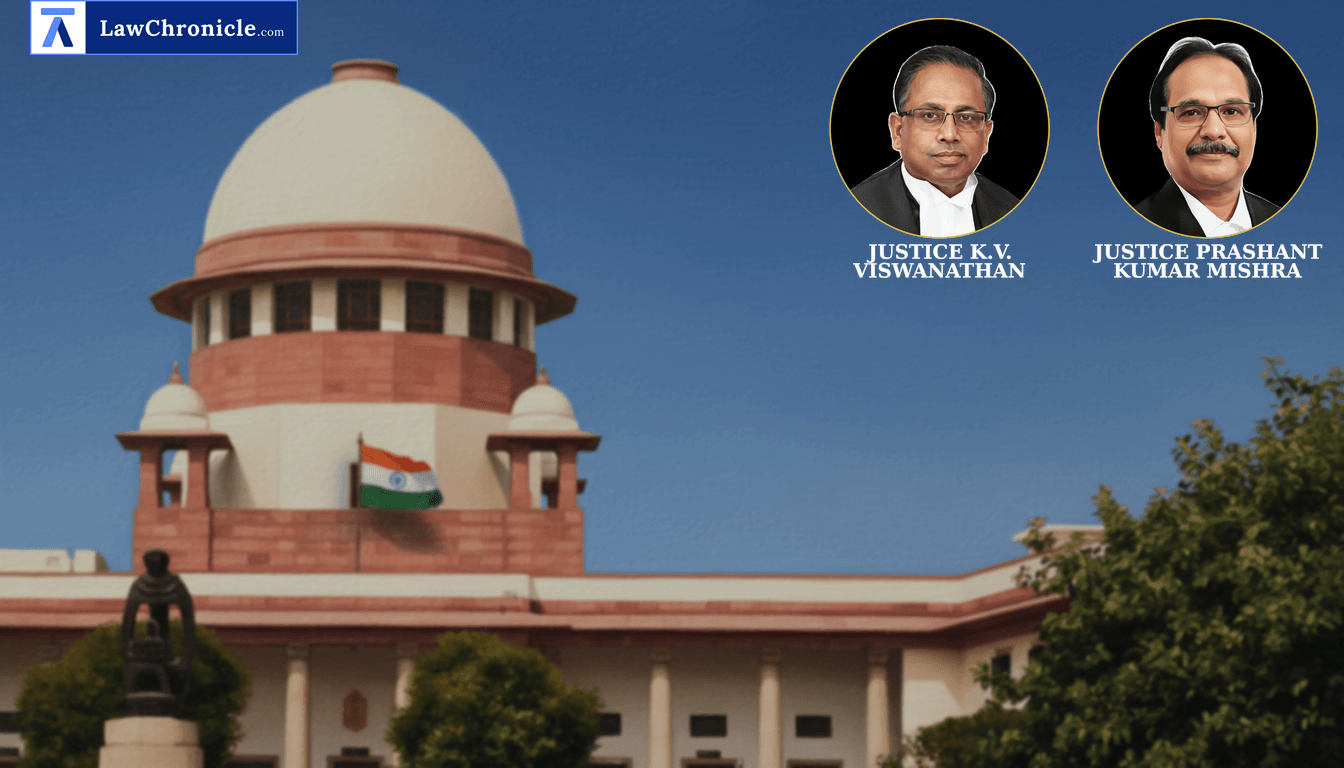
In a poignant reflection on the tragic consequences of societal pressure and marital cruelty, the Supreme Court upheld the conviction of a husband for the murder of his wife, ruling that the medical evidence of blunt force trauma and simulated hanging outweighed the defense's claim of suicide.
A bench of Justice Prashant Kumar Mishra and Justice K. V. Viswanathan heard the appeal challenging the High Court of Gauhati's decision which had confirmed the life sentence of the appellant for murder and dowry-related cruelty.
Medical Evidence Negates Suicide Theory
The Court focused significantly on the medical testimony which shattered the appellant's claim that his wife had committed suicide by hanging. The post-mortem examination revealed hematomas on the chest, jaw, and occipital area, along with a depressed fracture of the scalp, which the medical officer attributed to a blunt weapon like a hammer.
Homicidal Nature of Death
The Court observed that the lack of typical ligature marks, the absence of saliva dribbling, and the presence of internal head injuries pointed toward “homicidal hanging” a scenario where the victim is killed first and then suspended to simulate suicide.
The Court has the following directions:
"The appeal stands dismissed. We have been informed that the appellant is absconding. Now that we have dismissed the appeal, steps should be taken immediately to trace the appellant and take him into custody. Let a copy of this judgment be sent to the Director General of Police, Tripura, who shall immediately constitute a team and take steps to apprehend the convict."
The Doctrine of Privacy and Section 106 Evidence Act
A critical legal point addressed by the bench was the burden of proof when a crime is committed within the privacy of a home. Relying on the principles laid down in Trimukh Maroti Kirkan vs. State of Maharashtra ( "(2006) 10 SCC 681": 2006 CaseBase(SC) 500), the Court noted that when an offense occurs in secrecy, the inmates of the house bear a corresponding burden to explain the circumstances of the death.
The Court, in its reasoning, observed: "Where an offence like murder is committed in secrecy inside a house, the initial burden to establish the case would undoubtedly be upon the prosecution, but the nature and amount of evidence to be led by it to establish the charge cannot be of the same degree as is required in other cases of circumstantial evidence. The burden would be of a comparatively lighter character. In view of Section 106 of the Evidence Act there will be a corresponding burden on the inmates of the house to give a cogent explanation as to how the crime was committed. The inmates of the house cannot get away by simply keeping quiet and offering no explanation on the supposed premise that the burden to establish its case lies entirely upon the prosecution and there is no duty at all on an accused to offer any explanation."
Background:
The case arose from the death of Soma Acharjee on June 16, 2007, just fifteen months after her marriage to the appellant. According to the prosecution, the deceased was subjected to persistent torture and dowry demands, specifically for a motorcycle and cash. Despite multiple village panchayat meetings and resolutions intended to effect a compromise, the abuse continued.
The appellant had been convicted under Section 302 and Section 498A of the IPC by the Trial Court. While other family members (mother and brother) were eventually acquitted by the High Court due to living in separate dwelling units, the Supreme Court found the evidence against the husband to be overwhelming. The Court noted that the appellant was present in the house when the body was discovered and failed to provide any plausible explanation for the pre-death injuries. Consequently, the Court dismissed the appeal and ordered the immediate apprehension of the absconding appellant.
Case Details:
Case No.: CRIMINAL APPEAL NO. 1803 of 2014
NeutralCitation: 2026 INSC 535
Case Title: Gour Acharjee v. The State of Tripura & Ors.
Appearances:
For the Petitioner(s): Ms. Diksha Rai, Advocate
For the Respondent(s): Mr. Shuvodeep Roy, Advocate
Source: 2026 CaseBase(SC) 458
 Breaking News